Back to the Rhythm and Around Again
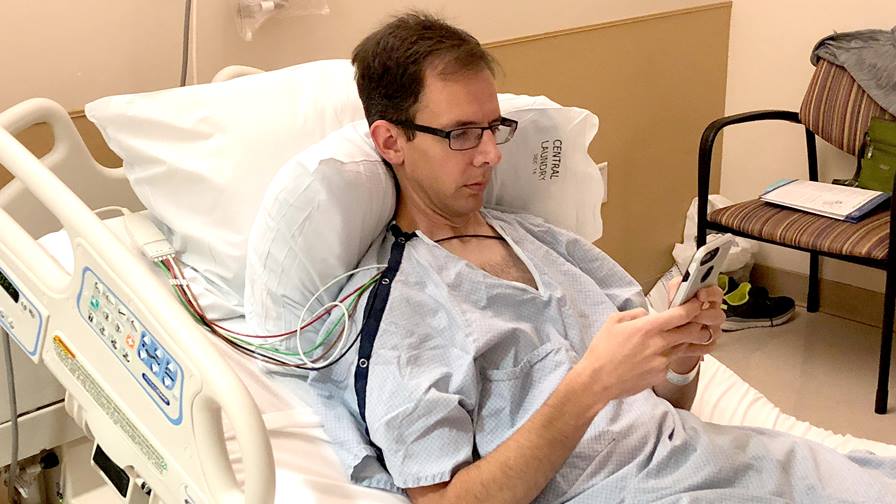
I couldn't sleep. My eye rhythm was in chaos and my mind was racing. I had a resting heart charge per unit of anywhere from 110 to 140 beats per minute. There was no consistency to the rhythm or forcefulness of my heartbeat. I was easily winded doing everyday tasks, felt uncomfortable in my chest, and if I stood up too apace, I'd go lightheaded. In short, I simply felt "off."
Even though I knew it was atrial fibrillation, which I'd been diagnosed with 18 months ago, the thought of being out of rhythm again worried me. I was physically and emotionally taxed. The electrical chaos going on in my heart was causing chaos in my caput and making it difficult to sleep.
I didn't feel I was in whatever immediate danger, but I'll admit I had some what-if-I fall-comatose-and-don't-wake-upwards-because-my-centre-throws-out-a-blood-clot-that-causes-a-life-catastrophe-stroke thoughts running through my head. Atrial fibrillation definitely creates some anxiety, to say the least.
What had caused my centre to become out of rhythm this time?
My best guess was stress. While I beloved running, I don't run frequently. When the opportunity came to run a Thanksgiving Twenty-four hour period 5k for a projection I was coordinating at piece of work, I took the challenge head on – but I probably should have taken some training head on first. I ran the race in 33.5 minutes, capturing the photos and videos I needed for work AND I trounce the local mayor to earn myself a medal. But I guess I also won a side dose of anarchy.
Three days later the 5k, I was still tired. I attributed it to the pace I kept upwards in the race. I tried checking my centre rate and discovered I had no rhythm. I fifty-fifty had my wife listen to my heart and she agreed the beats were sporadic and the strength of the heartbeats varied, too. As soon as the Intermountain Medical Center Eye Institute dispensary opened on Monday morning time, I was on the phone with a nurse who confirmed my fear and I was scheduled the following solar day to take my centre shocked dorsum into rhythm.
The treatment is known as a transesophageal echocardiogram (or TEE) followed past a cardioversion
In layman terms, they put a scope down my pharynx to capture images of my heart to brand certain no clots have formed in information technology due to the irregular middle rhythm. If it turns out to be clot-free, they have a pad on my chest and one on my dorsum and they deliver a shock to my heart. Having gone through two of these procedures, information technology's not every bit atrocious as information technology sounds – just similar anyone who has to become their heart shocked, at that place's some anxiety that accompanies the idea of swallowing a tube and getting shocked.
My experience was positive, and I was glad to share it publicly. I've worked closely with the team from the Intermountain Medical Center Heart Plant for the past iv years in my role as a public relations professional with Intermountain Healthcare.
I've helped share new technologies and research that give heart patients a second chance at life, returning to doing what they love with family and friends. Just I'd never been involved in sharing information nigh a TEE or cardioversion, and then I arranged for my feel to be shared alive on Twitter – including the moment 200 joules of electricity raced through my middle.
The day went something like this
Later checking in at the front end desk, I was taken to an exam room and put on a infirmary gown. I had monitors placed on my breast to follow my middle rate and they took my blood force per unit area besides. My BP was 115 over 93 and my heart rate was ranging from 110 to 140+ beats per minute, compared to a normal heart rate of lx to 100.
The next part of the prep piece of work definitely took me out of my comfort zone. I wasn't a fan of showing the world my breast, let lone having a strip of chest hair shaved off and so the cardioversion pad could be positioned. But it was just part of the process. When the teams began to assemble in my room, things started moving pretty fast.
After a brief conversation with cardiovascular electrophysiologist Jeffrey Osborn, MD, he got the procedure started past giving me some lidocaine to gurgle, swish, and swallow. That helped numb my pharynx for the TEE. The sense of taste wasn't bad – just it wasn't expert either. At the same time, fluids were hooked up to my 4 and medications were started to help sedate me for the procedure.
The last thing I call back was the doctor asking me to lay on my left side and a nurse placing a pillow backside me to aid proceed me on my side. I started to feel a little sleepy and shut my optics, and when I opened them, almost everyone had left the room and my centre charge per unit was hovering effectually a consistent 90 beats per minute. I was told the TEE was a success, and after sharing a tweet from my personal business relationship that everything went well, Dr. Osborn replied to my tweet: "One shock, that's all to restore rhythm to normal."
During the next hour, I looked to see what had been shared on Twitter while I was sedated so I could go a improve thought of what happened. After going into light sedation, the telescopic was inserted into my esophagus and images were taken of my heart, which showed it was healthy (other than the aberrant rhythm) and I had no claret clots.
One time that was completed, 200 joules of electricity shocked my heart back into rhythm. In fact, a brusque video of the "shocking feel" was posted to Twitter – which prompted some feedback from others around the country:
- Thank you for being willing to share this video! Too many #afib patients encounter terrifying vids online. This will help so many of u.s.. – Debbe McCall (@DebbeMcCall), a cardiovascular patient researcher and abet.
- Thanks for sharing the video and the fact sheets. Will be using to educate our patients and hopefully decrease some of the fears and concerns that they take. – Haide Landeros (@hidee27), a nurse practitioner in cardiology in California.
- Only a social media managing director would live tweet ain cardioversion. Amazing resources for patients. - @JediCath, an interventional cardiologist at Brigham Women's and Deaconess Hospitals in Massachusetts.
- I promise my friends at @Intermtnmedctr don't mind that I compiled these to make them easier to follow and to use as educational activity for patients? Thanks for live=tweeting your #cvTEE Guided #Cardioversion for #Afib. – John P. Erwin III, Doc (@HeartOTXHeartMD), a cardiologist at Baylor Scott and White Health in Temple, Texas.
The idea of getting your center shocked may sound — well, shocking – just information technology isn't anything to exist nervous nigh. I knew I was working with an amazing squad of heart experts from the Intermountain Medical Centre Eye Constitute, and they did everything possible to help me empathize the procedure, know what to expect, and ultimately return to doing what I love without worrying almost an abnormal rhythm or getting hands winded… although my wife has banned me from running any 5ks in the hereafter.
Hither's a recap of the journey equally it unfolded on Twitter.
Source: https://intermountainhealthcare.org/blogs/topics/heart/2018/02/shocking-the-heart-back-into-rhythm-isnt-as-shocking-as-it-sounds/
0 Response to "Back to the Rhythm and Around Again"
Post a Comment